Navigating Import Tariffs: Which Fiberglass Suppliers Are Truly Tariff-Free for US & EU
Nikhom Phatthana, Rayong, Thailand – September 7, 2026 – The Impact of US & EU Anti-Dumping Duties on Glass Fiber Reinforcements: Global trade policies have fundamentally altered the fiberglass procurement landscape. Punitive tariffs and anti-dumping duties (AD/CVD) have made direct imports from traditional manufacturing hubs financially unviable for many western enterprises.
For over a decade, both the United States and the European Union have systematically erected trade barriers to protect domestic industries from subsidized imports. The primary targets of these trade remedies are glass fiber reinforcements—including continuous filament glass fiber products, rovings, chopped strands, slivers, and woven fabrics. Importing these materials from restricted countries now subjects buyers to duties that can exceed 100% of the cargo value.
In the United States, Section 301 tariffs combined with localized anti-dumping margins have heavily penalized imports of Chinese glass fiber. Meanwhile, the European Commission has implemented stringent anti-dumping duties not only on direct Chinese exports but also on Chinese-invested operations in third-party nations like Egypt. This aggressive stance against circumvention means that simply changing the shipping origin is no longer sufficient; the manufacturing process must meet strict “rules of origin” criteria to be recognized as genuinely tariff-free.
Key Tariff Zones & Duty Rates
Understanding the duty structures imposed by the US Department of Commerce and the European Commission is critical for strategic sourcing.
- Chinese Origin: Subject to high US Section 301 tariffs (up to 25%) plus steep AD/CVD duties. Subject to EU anti-dumping duties ranging from 30% to 99.7%.
- Egyptian Origin: Subject to EU anti-dumping duties due to subsidies identified in Chinese-owned facilities operating in the Suez Economic Zone.
- Southeast Asian Sourcing: Generally exempt, provided that production is fully localized and integrated within compliant nations.
| Country of Origin | US Import Status (Section 301 & AD/CVD) | EU Import Status (Anti-Dumping Duties) | Compliance Risk Level |
|---|---|---|---|
| China | High Tariffs (Additional 25% under Sec 301 + AD/CVD) | High Anti-Dumping Duties (up to 99.7%) | Critical Risk |
| Egypt | Standard Duty Rates (MFA) | Countervailing / Anti-Dumping Duties Apply | Moderate-High Risk |
| Malaysia / Vietnam | Subject to circumvention scrutiny depending on input materials | Monitored for circumvention of Chinese glass fibers | Moderate Risk |
| Thailand (ACM Production) | Tariff-Free / Exempt (Full local tank furnace production) | Tariff-Free / Exempt (Compliant with EU Rules of Origin) | Low Risk / Compliant |
Tariff-Free Sourcing HubsRegions & Suppliers Exempt from Extra Tariffs: The Southeast Asian Advantage
To bypass these complex trade barriers, global manufacturers must source from regions that are certified exempt from punitive duties. Southeast Asia has emerged as the premier hub for compliant, tariff-free fiberglass production.
However, not all suppliers in Southeast Asia are equal. To qualify for tariff-free status in the US and EU, a supplier must demonstrate genuine localized manufacturing. This means the fiberglass must be drawn from a localized tank furnace rather than merely processed or packaged from imported Chinese glass cakes. This distinction is where Asia Composite Materials (Thailand) Co., Ltd. (ACM) stands out as a market leader.
Established in Thailand in 2011, ACM is the only manufacturer of tank furnace fiberglass in Southeast Asia. This integrated manufacturing process guarantees that all products originating from our facility are fully compliant with US and EU rules of origin, making them 100% exempt from anti-dumping duties.
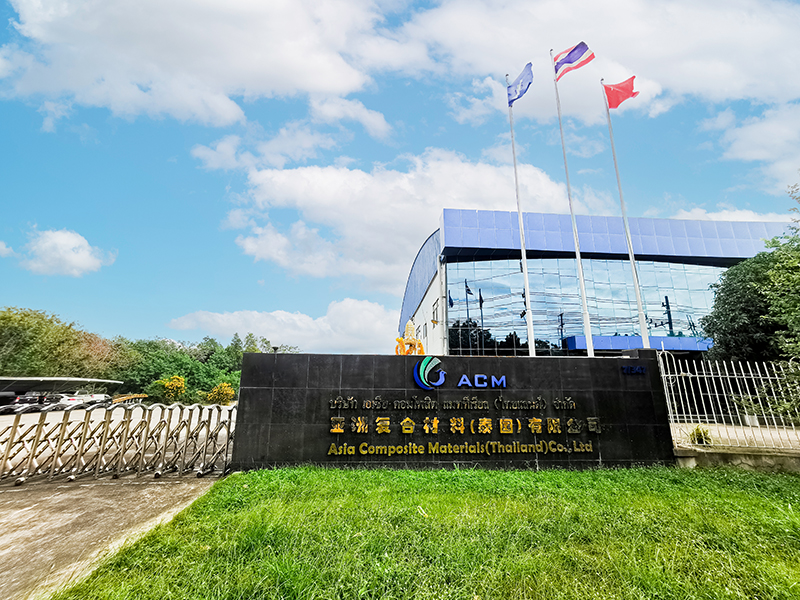
Asia Composite Materials (Thailand) Co., Ltd. at a Glance
A robust, fully-compliant manufacturing footprint in Southeast Asia.
100MAsset Size ($ USD)160KArea (Square Meters)400+Skilled Employees100KAnnual Capacity (Tons)Strategic Logistics & Location
ACM is located in the Rayong Industrial Park, which is the core area of Thailand’s “Eastern Economic Corridor” (EEC). It boasts an advantageous geographic location and extremely convenient transportation, ensuring rapid transit times to global markets:
- Laem Chabang Port: Only 30KM away (Thailand’s primary deep-sea port).
- Map Ta Phut Port: Only 30KM away.
- U-Tapao International Airport: Only 30KM away.
- Bangkok: Approximately 110KM away.
Production Capacity & Output
ACM has strong technical strength, integrating research and development, production, sales, and service. We have formed a complete industrial chain supporting the deep processing of fiberglass and its composite materials:
- Fiberglass Roving: 60,000 tons annual production capacity.
- Fiberglass Chopped Strand Mat: 30,000 tons annual production capacity.
- Fiberglass Woven Roving: 10,000 tons annual production capacity.
- Total Capacity: Expanding toward a composite material base with an annual output exceeding 140,000 tons.
Thailand Board of Investment (BOI) Approved
ACM’s operations conform strictly to Thailand’s strategic plan for industrial technology upgrading and have gained high-level policy incentives from the Thailand Board of Investment (BOI). These incentives, combined with our advanced manufacturing technology and strategic location, allow us to offer highly competitive pricing without compromising on quality or compliance.
Risk MitigationStrategic Sourcing Solutions for Global Procurement Managers
To protect your business from sudden tariff hikes and supply chain disruptions, a proactive sourcing strategy is essential. Relying on single-source origins is no longer a viable long-term plan.
Fiberglass and composite materials have a wide range of substitution effects on traditional materials such as steel, wood, and stone. They have rapidly developed into essential basic materials for modern industries, with broad application areas and huge market potential. Key sectors include construction, transportation, electronics, electrical engineering, chemical processing, metallurgy, environmental protection, national defense, sports equipment, aerospace, and wind power generation.
Since the world economic crisis in 2008, the new materials industry has consistently rebounded and risen strongly, proving that the composite materials sector has considerable room for development. To capitalize on this growth, procurement managers must secure supply chains that are resilient, scalable, and completely compliant with international trade laws.
1. Verify Origin Compliance
Ensure your supplier utilizes an integrated local tank furnace. Simple processing or repackaging of imported glass fiber cakes does not bypass US/EU anti-dumping duties.
2. Leverage Free Trade Zones
Partner with suppliers located in specialized industrial zones, such as Thailand’s Eastern Economic Corridor (EEC), to benefit from streamlined customs and logistics.
3. Secure Long-Term Capacity
Establish contracts with high-capacity manufacturers like ACM (100,000+ tons combined capacity) to guarantee consistent supply during market fluctuations.
Product PortfolioHigh-Performance Fiberglass Solutions
We continue to consolidate the complete industrial chain mode from glass raw material production, fiberglass manufacturing, to deep processing of fiberglass chopped strand mat and woven roving.
Fiberglass Roving
Engineered for filament winding, pultrusion, and weaving applications. Offers excellent mechanical properties, fast wet-out, and high compatibility with various resin systems.
Chopped Strand Mat (CSM)
Uniform weight distribution, excellent tensile strength, and rapid wet-through. Ideal for hand lay-up, mold casting, and automotive body panels.
Woven Roving
High-performance bi-directional fabric compatible with unsaturated polyester, vinyl ester, and epoxy resins. Widely used in marine, wind energy, and industrial piping.
Regulatory FAQ Frequently Asked Sourcing Questions
Why are Chinese fiberglass imports subject to such high duties in the US and EU?
Both regions have determined that state subsidies allow Chinese manufacturers to export glass fiber reinforcements at prices below fair market value, harming domestic industries. As a result, anti-dumping and countervailing duties (AD/CVD) are applied to restore competitive balance.
How does ACM Thailand guarantee tariff-free import to the US and EU?
ACM operates a fully integrated tank furnace facility in Rayong, Thailand. Because the fiberglass is drawn and manufactured locally from raw materials, it complies with the strict “substantial transformation” rules required by US Customs and Border Protection and the European Commission, exempting it from Chinese and Egyptian anti-dumping duties.
What logistics benefits does sourcing from Thailand offer?
ACM’s facility is located just 30 kilometers from Laem Chabang Port, Thailand’s primary deep-water port. This proximity minimizes inland freight costs, reduces shipping lead times, and ensures reliable, year-round dispatch to North American and European ports.
About us
Asia Composite Materials (Thailand) Co., Ltd (hereinafter referred to as “ACM) established in Thailand in 2011 and is the only manufactory of tank furnace fiberglass in Southeast Asia. Company assets worth 100,000,000 US dollars and cover an area of 100 rai (160,000 square meters). ACM has more than 400 employees. Our customers are from Europe, North America, Northeast Asia, the Middle East, South Asia, Southeast Asia, and other regions.
Media Contact
Company Name: Asia Composite Materials (Thailand) Co., Ltd.
Contact Person: Media Relations
Email: Send Email
Country: Thailand
Website: https://www.acmfiberglass.com/


